Flat roof repairs in Yorkdiagnosed and fixedno patches, no comebacks.
Ponding, splits, blistering, failed laps and leaking upstands, repaired with the correct system, correctly detailed. So the same fault doesn't reappear the first hard winter after we leave.
Flat roof repair means fixing the specific failure mode without disturbing the sound membrane around it. That could be a targeted patch, a re-lapped seam, a new outlet, a reinforced upstand, or a decision to replace, because sometimes patching is the more expensive answer.
Who it's for
Homeowners with a leaking extension, garage or dormer, and landlords with recurring ceiling stains. Anyone who's already paid for one 'quick fix' that came back within a season.
When you need it
The moment you see ponding that never dries, a blister raising like a mushroom, a moss line at a seam, or an interior stain. Left alone, a small failure becomes structural deck rot.
Why it matters
A patch that ignores the cause doesn't outlast the tube of mastic it came from. Real flat roof repair is diagnosis first, correct material second, detail third, and it's what the price-only jobs skip.
What happens if it's ignored
Small problems don't stay small.
A roof issue left alone compounds quickly. Water tracks, timber rots, and repair scope escalates by season. Here's what we see when a customer waits.
Persistent ponding water
Standing water doubles the thermal and UV load on a membrane. What starts as a discoloured patch becomes a soft, delaminated section by the following winter, and then a hole.
Blistering and delamination
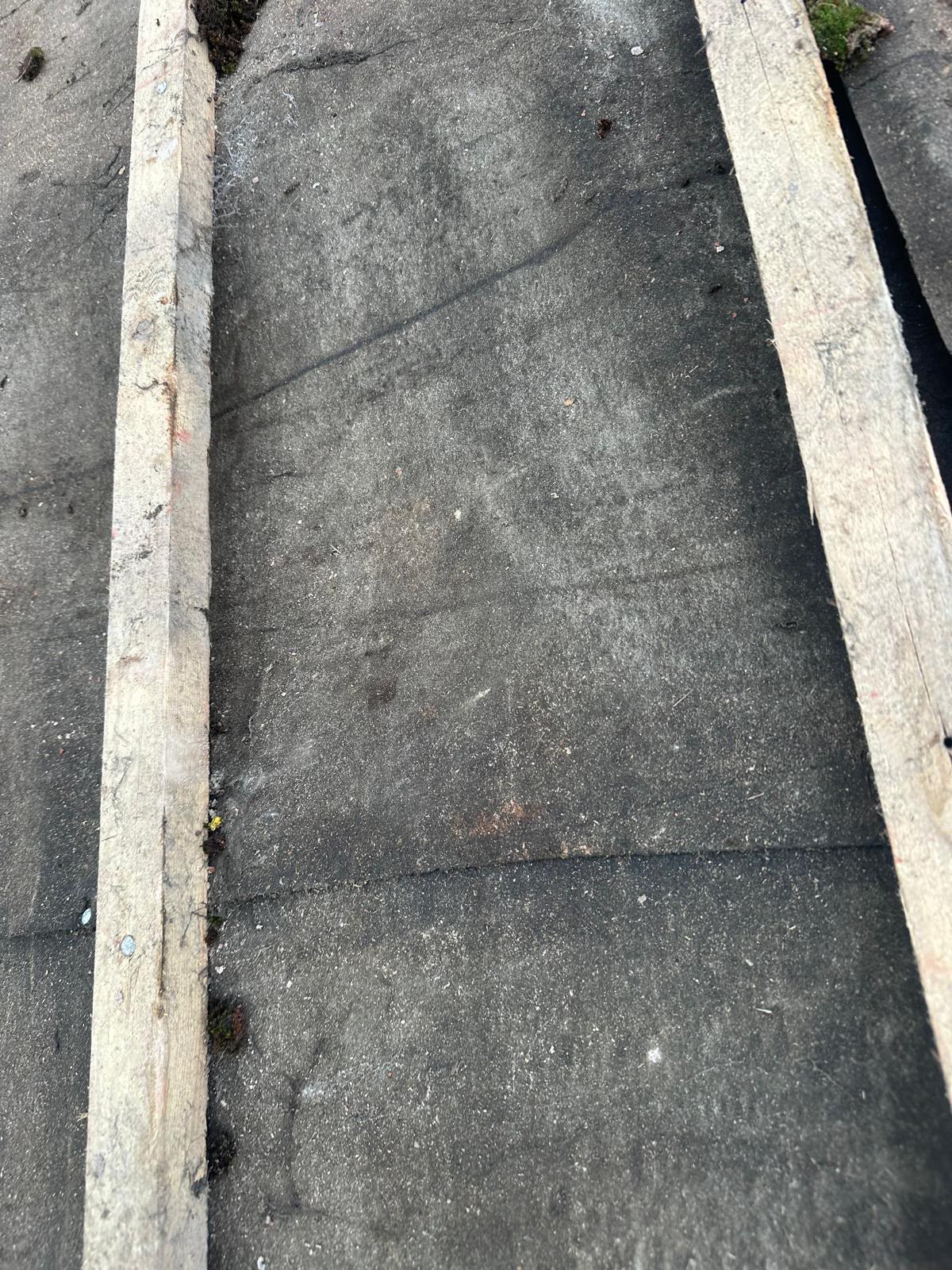
Air or moisture trapped between layers expands with temperature. Blisters don't self-heal; each thermal cycle grows the fault until the top layer splits.
Failed seams and laps
Every failed seam is a straight-line entry point for water. On old felt roofs, the lap adhesive dries and lifts; on cheap EPDM, primer skipped at overlaps fails within 2–3 years.
Rotting deck under a sound-looking cover
A membrane can look fine while the OSB or ply beneath it is spongy. We always probe for a soft deck, because putting a new membrane over rot is money burned twice.
Our process
From first call to final tidy-up.
01
Same-day inspection
We come out promptly, walk the roof, probe the deck and photograph every detail. You get an honest read of whether it's repairable or whether replacement is the right call.
02
Root-cause diagnosis
Every repair is priced against the actual failure, ponding, blister, seam, upstand, outlet, not a generic 'flat roof' job.
03
Fixed-price written quote
A written fixed-price quote within 6 hours landing the same day. Scope, materials, time and price, all set before we start.
04
Repair with matched materials
We use system-compatible primers, tapes and membranes, no bitumen paint over EPDM, no silicone over felt. If it was fibreglass, it stays fibreglass; if it was EPDM, we bond in a matched sheet.
05
Water test, guarantee, walk-off
We water-test outlets and re-check upstands, then issue the 10-year written workmanship guarantee on completion.
Why homeowners pick us
What you actually get.
Fast response, fast quote
Same-day inspections where possible and 2-hour emergency response for active leaks. Written quote back within 6 hours.
Repair that outlasts the roof
A correctly patched EPDM or fibreglass repair matches or beats the surrounding membrane's remaining life, we don't shortcut with mastic or silicone.
Fixed price, before we start
You get one clear written number. No 'while we're up here' extras once the deck is opened.
Deck replaced where it's rotten
We refuse to lay new membrane over wet or soft deck. It's the single biggest cause of a re-failed flat roof, and it isn't a saving.
10-year workmanship guarantee
The full 10-year written workmanship guarantee applies to repairs as well as full installations.
Emergency make-safe
For storm and impact damage we make-safe first, tarpaulins fixed correctly, gutters cleared, water contained, and permanent-repair after.
The detail
Materials, methods and where they apply.
Not every flat roof failure needs a full replacement. Below are the most common issues we repair, and how we approach each one on domestic and light-commercial buildings across Yorkshire.
Where an existing roof holds water because the falls are inadequate, we install tapered insulation cuts under a fresh membrane to introduce a proper minimum 1:80 fall. This is more work than a like-for-like patch, but it's the only way to stop the ponding coming back with the next membrane.
Blister and split repair
On modern SBS felt, a blister is cut open in a cross pattern, the substrate dried, and a two-layer patch bonded and heat-sealed in. On EPDM, the affected sheet is peeled, primed and re-bonded with a matched piece extending 150mm beyond the fault in all directions.
Seam and lap repair
Failed laps on felt are cut back, the substrate cleaned and dried, and a new torched-in lap formed with fresh adhesive. On EPDM, we clean, prime and re-tape the seam with system tape, never generic mastic.
Felt, torched cap sheet lap, minimum 100mm cover
EPDM, primer + cured cover strip
GRP, fresh matting bonded into original laminate
Upstand, outlet and abutment repairs
Most flat roof leaks come from the edges. We re-form upstands to a minimum 150mm above finished level, dress fresh lead over the top edge, and fit pre-formed pipe collars and drainage sumps rather than field-cut circles. It's slower, and it's the reason the repair lasts.
Deck replacement
Where the substrate is soft, we strip the affected area, replace with matched-thickness OSB3 or WBP ply screwed to firrings, and re-membrane. Where more than about 25% of the deck is soft, we recommend and price a full replacement instead, it's the cheaper answer honestly.
Residential vs commercial
Domestic flat roof repairs are usually single-visit affairs completed inside a day. Commercial repairs on trafficked or plant-loaded roofs (air-con condensers, cable runs) need reinforced patches and often walk-boards, priced fixed, and phased outside your trading hours where possible.
FAQ
Straight answers, no waffle.
How much does a flat roof repair cost?+
Small localised repairs (single split, blister, one seam) typically sit between £180–£450. Multi-fault repairs and upstand rework are usually £500–£1,200. Every job is quoted fixed in writing after inspection.
Can a leaking flat roof be repaired or does it need replacing?+
If the deck is dry and less than 20–25% of the covering is failing, a repair is almost always the right answer. If the deck is wet or blistering is widespread, replacement is cheaper long-term, we tell you honestly which category yours is in.
How long will a flat roof repair last?+
A correctly executed repair carries our full 10-year workmanship guarantee and, where system-compatible materials are used, matches the surrounding roof's remaining service life.
Can you repair a felt roof with EPDM?+
Not directly, different systems don't bond reliably. We either replace the entire covering with EPDM, or we repair felt with felt. We'll never mix systems on the same substrate as a shortcut.
How quickly can you get out for a leak?+
Emergency response inside 2 hours day or night, with a make-safe on the spot and a permanent repair booked as soon as the weather allows.
Will I need scaffolding for a repair?+
Rarely, most single-storey extensions and garages are reached from proper ladders and towers. Second-storey dormer flat roofs and larger commercial repairs sometimes need scaffold; we include it in the quote when it's required.
Do repairs affect my membrane's manufacturer warranty?+
System-compatible repairs using approved materials don't void the manufacturer warranty. We document what we've used so your warranty history stays clean.
Can you help with an insurance claim from storm damage?+
Yes, we provide condition reports and photographs suitable for insurance submission and liaise with loss adjusters where you'd like us to.